
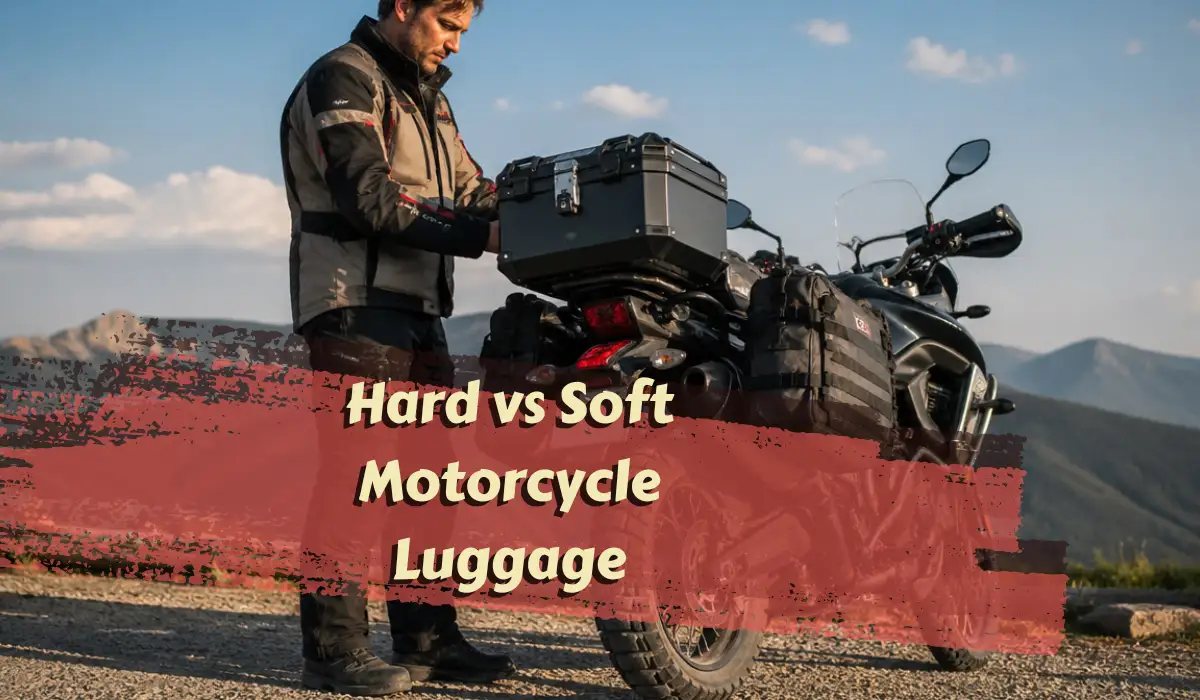
Hard vs soft motorcycle luggage is really a question about your riding, not your gear taste.
If you spend most of your time commuting, touring on pavement, and leaving the bike parked with gear on it, hard luggage usually makes more sense. If you ride dirt, expect drops, or want to keep the bike light and narrow, soft luggage usually makes more sense. And if you do a bit of both, a mixed setup is often the smartest answer.
This guide breaks the choice down the way riders actually feel it on the road: security, crash behavior, weight, weather, cost, and daily convenience. If you still want the full category picture first, start with the main motorcycle luggage guide.
Jump Ahead To:
What Hard vs Soft Motorcycle Luggage Really Means
Hard luggage uses rigid cases. Usually that means aluminum panniers, plastic side cases, or a hard top box mounted to a bike-specific rack. The big draws are structure, lockability, and quick access.
Soft luggage uses textile, TPU, PVC, or similar bag systems. That can mean rack-mounted soft panniers, throw-over saddlebags, rackless systems, tail bags, or hybrid bags with some internal structure. Modern soft luggage is a lot better than the old floppy bag setups many riders still picture. Good systems stay planted, keep water out, and survive repeated drops far better than cheap soft bags used to.
The key point is simple: this is not old-school "metal boxes vs cheap saddlebags." Today the real choice is rigid, lockable, easy-access storage versus lighter, more flexible, crash-tolerant storage.
Fast Answer: Which One Makes More Sense for Your Riding?
If you want the short version:
- Hard luggage usually wins for commuting, paved touring, hotel-stop travel, and any ride where you care most about lockable storage and fast access.
- Soft luggage usually wins for ADV riding, rough roads, smaller bikes, lower weight, lower cost, and routes where drops are part of the day.
- A hybrid setup makes sense when you want hard-case security for daily use but softer, lighter luggage for dirt-heavy trips.
That is why this debate never really ends. Both systems work. They just solve different problems better.
Hard Luggage: Where It Wins
Hard luggage is easiest to live with when your bike works like a travel tool. You stop for fuel, coffee, photos, or groceries, hit the latch, grab what you need, and close it again. No roll-top to re-fold. No compression straps to re-route. No loose webbing to deal with in the wind. If your main worry is leaving gloves, tools, rain gear, or electronics on the bike for short stops, hard cases still set the baseline for convenience.
Security is the other big reason riders choose hard cases. A lockable side case or top box is not thief-proof, but it is far better by default than an unsecured soft bag. That matters in city parking, on work commutes, and during stop-heavy tours. If theft resistance is a major part of your decision, pair this article with the motorcycle luggage security guide and compare real-world top box options if you want the quickest daily-access setup.
Hard luggage also makes packing simpler. The shape stays the same whether it is full or half empty, and the flat interior is easier to organize. That matters on road trips where you keep reaching for chargers, layers, or camera gear. Hard cases are also usually the easier weather solution day to day. When seals are in good shape, you close the lid and move on.
Hard Luggage: What You Give Up
The price of that convenience is bulk. Hard panniers add real weight before you pack a single thing, and the rack adds even more. On bigger adventure bikes that may be acceptable. On smaller bikes, or in slow technical riding, that extra weight shows up fast. The bike feels wider, slower to correct, and easier to overload. If you already struggle with rear-heavy packing, read the motorcycle luggage weight distribution guide before you bolt on a big hard-case setup.
Width is the other problem riders notice right away. Many hard panniers stick out farther than the bars. That is bad news in traffic, tight trails, gates, rocky two-track, and parking spaces where every inch matters. Hard cases can also catch obstacles more easily because the leading edge is rigid and square.
Crash damage is another tradeoff. A hard case can take a hit, but once a latch, mount, hinge, or seal gets bent, the problem is not always a quick trailside fix. Some metal boxes can be hammered back into shape, but damaged hardware can turn a simple spill into an expensive repair. And because hard luggage gives you so much neat square space, it also makes it easy to pack more than you should. If you are planning a full hard setup, good luggage rack options and careful load planning matter more than most riders think.
Soft Luggage: Where It Wins
Soft luggage wins when the ride gets rough. It is lighter, narrower, and more forgiving when the bike goes down. That is why dirt-focused riders, backcountry travelers, and smaller-bike ADV setups lean soft so often. A quality soft pannier or rackless system can slide, flex, and keep going in a way hard cases often cannot.
Soft luggage also gives you more freedom in how you build the bike. You can run rack-mounted soft panniers, go fully rackless to save even more weight, or keep things simple with saddlebags or a well-mounted tail bag for lighter travel. Many systems also move from bike to bike more easily than hard luggage because you are not locked into one case shape and one rack design.
Cost usually favors soft luggage too. Even good soft systems are often easier to get into than a full hard-case-and-rack package. And if you ride off-road enough to drop the bike now and then, soft luggage tends to be cheaper to live with long term because it is less likely to leave you with bent mounts or damaged latches after one bad fall.
Soft Luggage: What You Give Up
Soft luggage asks more from you every day. Access is slower. Packing takes more thought. Compression straps, roll tops, and mounting straps all have to stay tidy. If you are the kind of rider who is in and out of your luggage all day, hard cases feel easier because they are easier.
Security is the weak point most riders notice first. Even when a soft bag has a lock strap or cable pass-through, it still does not give the same default peace of mind as a locked hard case in a parking lot. Soft luggage can narrow the gap with steel-core straps, cable systems, and smarter parking habits, but it usually does not erase it.
Heat and mounting discipline matter more too. A soft bag that shifts toward the exhaust can turn into a real mess fast. Rackless systems save weight, but they need proper support and careful setup. If you go soft, spend time with how to mount motorcycle luggage safely and build a real waterproof packing system instead of assuming every soft bag is storm-proof just because the ad copy says so.
Rack-Mounted vs Rackless Soft Luggage
This is the sub-choice that changes a lot of soft-luggage decisions.
Rack-mounted soft luggage usually feels more planted. The bags have a defined mounting point, stay away from hot exhausts more easily, and are less likely to move around under load. If you ride longer distances with a heavier kit, or want a softer version of the hard-pannier experience, rack-mounted soft bags are a smart middle ground.
Rackless luggage strips things back. You save the weight and cost of metal racks, the bike stays slimmer, and the whole system usually transfers between bikes more easily. That makes rackless luggage especially attractive on dual sports, smaller ADV bikes, and any setup built around light packing and rough terrain.
The tradeoff is that rackless systems need more care in setup. They work best when the bike shape, exhaust clearance, and load balance all play nicely together. When they do, they are excellent. When they do not, they can become the kind of luggage you keep adjusting instead of trusting.
Security, Weather, and Convenience Compared
Security
Hard luggage wins on security by default. Locked cases attached to a rack are simply harder to mess with during normal stops. That does not make them impossible to break into, but it does raise the effort and time needed.
Soft luggage can get closer than many riders think. Steel-core lock straps, cable systems, and good parking habits all help. But if your bike spends a lot of time outside offices, hotels, restaurants, or tourist stops with gear left behind, hard luggage still has the edge.
Weather
Hard luggage is easier in day-to-day bad weather because it is a simple close-the-lid system. No folding. No re-cinching. No extra thought. But it is not magic. Damaged seals, bent lids, and worn latches can still let water in.
Modern soft luggage can be just as weather-ready when the bag uses proper materials, welded seams, and a solid closure design. Some riders still use inner dry bags even with hard cases, and that is not overkill. If dry gear really matters, the best answer is not blind trust in either system. It is redundancy.
Convenience
Hard luggage is faster. That is the cleanest way to say it. Hard cases are easier when you stop often, sort gear often, or treat the bike like daily transport.
Soft luggage is less convenient in those little moments, but it can be more convenient in the bigger picture because it is lighter, easier to move between bikes, and often easier to live with after a crash. So ask yourself what kind of convenience matters more: quick access at every stop, or less hassle when the ride gets rough.
Safety and Crash Behavior Compared
For off-road riding, soft luggage is usually the safer bet.
The reason is not complicated. Soft luggage gives more in a fall, carries less rigid mass out at the sides, and is less likely to pin or strike your leg with a hard edge when things go wrong. That matters most in the exact situations where ADV riders dab a foot, catch a rut, or tip over in sand, rocks, or mud.
Hard luggage has defenders here, and some riders do like the protection it can give the bike or the gear inside. But when the question is rider safety in rough terrain, soft still gets the nod. On the street and in low-drama touring use, the gap matters less. In the dirt, it matters more.
Weight, Cost, and Repairability
If you want the lighter setup, soft luggage wins almost every time. That gap gets even bigger when you compare rackless soft luggage with hard panniers plus a full rack system. On a large ADV bike that extra weight may feel manageable. On a 300 to 500 class dual sport or lightweight ADV bike, it changes the ride a lot.
Soft luggage also tends to cost less for a complete usable setup. That does not mean every soft system is cheap, but it does mean the full entry cost is often easier to swallow than buying hard cases, bike-specific mounts, and all the supporting hardware.
Repairability is more complicated. A dented aluminum case can sometimes be beaten back into shape. But once mounts, latches, hinges, or seals are damaged, the fix can stop being simple. Soft luggage can tear too, but many soft systems are easier to patch, tape, sew, or strap back into service long enough to finish a trip. For riders who care about field fixes more than clean garage fixes, that matters.
When a Hybrid Setup Makes Sense
A hybrid setup is not a compromise. For many riders it is the best answer.
One common mix is a hard top box with soft side luggage. That gives you one lockable place for valuables, chargers, paperwork, and quick-access daily gear while keeping the side setup lighter and more forgiving off-road. Another smart move is running hard luggage for weekday commuting and hotel-based touring, then swapping to soft bags for backcountry or BDR-style rides.
Hybrid thinking also helps if your bike does more than one job. A commuter who also camps on weekends does not need to force one luggage system to be perfect at everything. It is often better to build two good use cases than one mediocre do-it-all setup.
How to Choose the Right Setup for Your Riding Style
Urban commuting and regular parking
Lean hard. Lockable storage and fast access matter more here than crash tolerance. A hard top box or compact hard side case setup is usually easier to live with.
Mostly paved touring and road trips
Usually lean hard, especially if you stop often, carry electronics, or leave the bike loaded while you eat or sleep. If you want less bulk and do not care as much about lockability, soft can still work.
ADV and off-road riding
Lean soft. The lighter weight, narrower profile, and better crash behavior make more sense once dirt, sand, rocky climbs, and regular tip-overs enter the picture.
Weekend riders and smaller bikes
Soft or rackless often makes more sense. The bike stays lighter, the setup costs less, and you avoid hanging a lot of hardware on a machine that may only need moderate carrying capacity.
Common Mistakes Riders Make
- Buying for looks instead of route type.
- Choosing hard luggage for technical dirt without thinking about width, weight, and fall behavior.
- Choosing soft luggage for city parking without adding any theft layers.
- Assuming "waterproof" means no liner, no checks, and no backup plan.
- Adding huge cases, then overpacking because the space is there.
- Treating one setup like it has to be perfect for commuting, touring, camping, and tight off-road work all at once.
Frequently Asked Questions
Is hard luggage always more secure than soft luggage?
Usually yes in normal parking situations because hard cases are rigid and lockable. Soft luggage can get closer with lock straps and cables, but hard still starts from a stronger security position.
Is soft luggage really safer off-road?
Usually yes. It is lighter, less rigid, and less likely to trap or strike your leg with a hard edge in a fall.
Which is better for long highway touring?
Hard luggage usually feels easier on long road trips because it is quick to access, simple to organize, and more reassuring when the bike is parked with gear on it.
Can soft luggage be truly waterproof?
Yes, but only when the construction is good and the closure is used correctly. Good soft luggage can stay very dry, but you still need to pack with some caution.
Do hard panniers make a bike too wide?
Sometimes, yes. Many hard panniers are wider than the bars, which matters in traffic, on narrow trails, and around obstacles.
Is rackless luggage good enough for long trips?
Yes, if the bike, the luggage, and the packing style all match. Rackless works very well for riders who pack light and set the system up correctly.
When does a hybrid setup make more sense than choosing one side?
It makes sense when your bike has more than one job. Many riders want lockable storage for daily use and a lighter, safer setup for dirt-heavy travel.
What is the best choice for a small ADV or dual-sport bike?
Soft luggage is usually the better fit because it keeps weight down and does not ask the bike to carry a lot of extra rack and case mass.
If you are narrowing down a full setup, compare saddlebag options for side storage, tail bag picks for lighter travel, tank bag options for quick-access gear, and waterproof packing strategies if weather is part of the plan.