
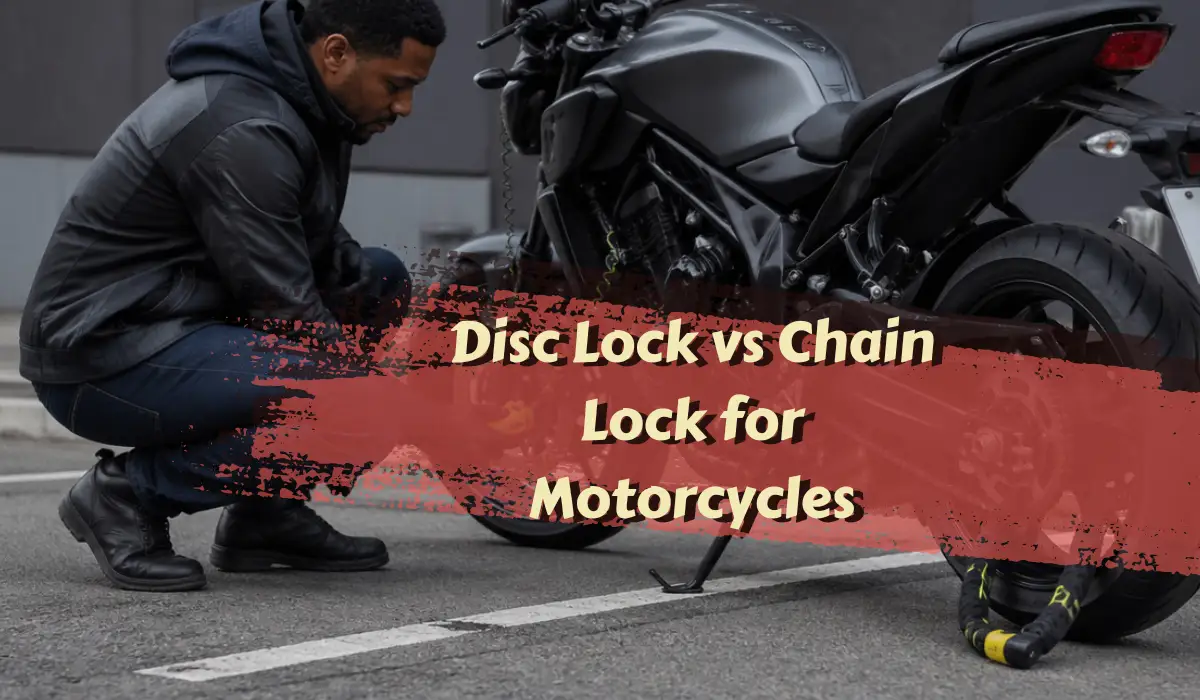
Is a disc lock better than a chain lock for motorcycles? It depends on where and how long you park. One is better for portability and quick stops, while the other is better for anchored overnight security.
Most riders do not need to choose only one forever. The stronger strategy is choosing the right primary lock for your risk level, then adding a second layer when parking risk goes up.
Jump Ahead To:
What Changes Between Disc Locks and Chain Locks
A disc lock immobilizes wheel rotation. It is compact, fast to install, and easy to carry. That is why many riders use one for commuting and short errands.
A chain lock lets you anchor the bike to a fixed object. This is the key advantage. Anchoring helps prevent lift-and-load theft, which a disc lock alone cannot stop.
If you need product-level options, compare best motorcycle disc locks and best motorcycle chain locks.
Why This Decision Matters
The wrong lock type creates blind spots. Riders who only use disc locks in high-risk areas are vulnerable to van-lift theft. Riders who only use heavy chains may skip locking on short stops because carry weight is annoying.
The right lock is the one you will actually use every time, with enough security for your parking scenario.
Key Concepts That Decide the Winner
Portability
Disc locks win on carry convenience. Chain locks can be heavy and hard to stash on smaller bikes.
Anchoring
Chain locks win because they can secure your bike to a fixed object or a best motorcycle ground anchor setup.
Attack resistance profile
Both can be defeated with enough time and tools. Better hardware only increases time, noise, and effort required.
Layered security
For high-risk parking, combine lock types and add alarm deterrence from the best motorcycle alarms guide.
At-a-Glance Winner by Scenario
If you want the shortest answer, disc locks win for convenience and chain locks win for anchoring. The problem is that riders often choose based on convenience alone, then expect the lock to cover a completely different risk level later.
For daily commuting, coffee stops, and travel where you need something small, a disc lock usually makes more sense. For home parking, overnight street parking, or anywhere a van-lift theft is realistic, a chain to a fixed object is the stronger answer.
If you regularly park in more than one type of environment, the best setup is usually not choosing one winner forever. It is having a lightweight daily option and a heavier home-base option.
When Disc Locks Win
Disc locks win when speed and portability decide whether you lock the bike at all. They are fast to install, easy to store under a seat or in a small bag, and simple enough that riders actually deploy them on short stops.
They also work well for route days and touring because they add visible deterrence without turning your luggage plan into a security-hauling exercise. That matters more than many riders admit. A lock you leave at home because it is annoying is worse than a slightly lighter lock you always use.
An alarmed disc lock can add two practical benefits at once: more attention when the bike is disturbed and a stronger reminder that the lock is still on the rotor. If you use disc locks regularly, that reminder value alone matters.
Where Disc Locks Fall Short
The main weakness is simple: a disc lock does not anchor the motorcycle to anything. It stops the wheel from rolling, but it does not stop multiple thieves from picking the bike up and loading it into a van.
That is why disc locks become weaker as parking time and theft pressure rise. They are useful delay tools, but they are not complete overnight security on their own in exposed areas.
They also create a rider-side risk if you get casual about reminder habits. Forgetting a disc lock and trying to move the bike can damage components fast, so reminder cables and consistent routine matter.
When Chain Locks Win
Chain locks win when the question is not just "Can someone roll the bike away?" but "Can someone take the whole bike?" Anchoring the motorcycle to a post, rail, or best motorcycle ground anchor changes the theft problem completely.
That is the biggest reason chains remain the default answer for serious home security. A correctly placed chain through a strong part of the bike and around something immovable does far more against lift-and-load theft than a disc lock ever can.
They also give you flexibility that fixed-shape locks sometimes do not. A chain can wrap around awkward posts, thicker anchor points, or garage hardware in a way that a compact lock body cannot.
Where Chain Locks Fall Short
The obvious downside is weight. Serious motorcycle chains get heavy fast, and that affects whether riders carry them consistently. Once chain weight pushes into several kilograms, many riders stop treating them like everyday travel gear.
That is not just an inconvenience issue. It is also a crash-safety issue if riders carry very heavy chains in a backpack or other poor body position while riding.
Chains also have to be used correctly to deliver their real advantage. A loose chain on the ground gives thieves better leverage and a better striking surface. A chain through only a removable wheel also leaves a predictable weakness.
The Real Decision: Carry System vs Parking System
The simplest way to think about this comparison is that disc locks are usually carry-system locks and chain locks are usually parking-system locks.
A carry-system lock is the thing you can bring everywhere without changing how you ride. That is where disc locks shine. A parking-system lock is the heavier gear you leave at home, at work, or in your main overnight spot because it is too valuable there to skip. That is where chains shine.
Once riders separate those two jobs, the decision gets easier. You stop asking one lock to solve every situation and start building a routine that matches real use.
Decision Flow by Parking Scenario
- If parking is short and low risk, start with a good disc lock.
- If parking is medium-to-high risk, use a chain to a fixed anchor.
- If parking is overnight outdoors, use chain + anchor plus a second lock layer.
- If you cannot carry heavy gear daily, use a compact daily lock and keep heavier equipment at home base.
For complete routine setup, follow how to lock a motorcycle outside.
Practical Setup Examples
City commute with short stops
Use a compact disc lock for speed and add an alarm if theft pressure is rising.
Street parking for several hours
Use a chain to a fixed object. Add disc lock or grip lock as secondary delay.
Home driveway or garage parking
Use chain plus fixed anchor as primary security, then add a second immobilizer layer.
For related lock formats, compare best motorcycle U-locks, best motorcycle grip locks, and best motorcycle wheel clamps.
What to Buy Based on Your Routine
If you have under-seat space, a tail bag, or just enough room for a compact security item, start with a disc lock. It is the most realistic way to make sure you still lock the bike during ordinary stop-start riding.
If you park overnight in one main place, spend the bigger part of your budget on a chain-and-anchor setup for that location. That gives you the most meaningful security gain for home or repeated overnight parking.
If you want one lock to do everything, that is usually where compromises get expensive. Riders often end up with a chain too heavy to carry or a disc lock they expect to protect like an anchored system.
If carry weight is the blocker but you still want anchoring, a compact high-security best motorcycle U-locks setup can sometimes bridge the gap better than a full heavy chain, assuming your parking points and bike geometry allow it.
Setup Rules That Matter More Than the Lock Type
Lock placement changes performance almost as much as the hardware does. A chain should go through the frame or a strong rear-wheel area and stay as tight and elevated as practical. A disc lock should sit where it is easy to notice and hard to forget.
Do not treat the steering lock as your real security layer. It is only a minor delay. Your primary protection should come from a physical lock that meaningfully slows removal or movement.
Also avoid using cable locks as the main answer for the bike itself. They are fine for accessories or secondary tie-ins, but they are not a substitute for real motorcycle lock hardware.
Certification and Hardware Thresholds
When you are comparing serious options, certification matters more than marketing adjectives. As a rough minimum, look for independent testing aimed at motorcycles, not just general bike-security language.
Sold Secure Powered Cycle Gold is a useful floor for stronger motorcycle security, while Powered Cycle Diamond is the higher benchmark when you are shopping at the top end. Those ratings do not mean a lock is unbreakable, but they are still more useful than generic "heavy-duty" claims.
For chains, link thickness remains a useful shorthand. Thicker links generally resist manual cutting better, and once chains get into the heavier motorcycle-security range they become much harder to defeat with manual bolt croppers. The tradeoff is that they become far less pleasant to carry.
If You Can Only Buy One First
Buy a disc lock first if your immediate need is commuting, short public stops, or travel where carry space is tight. That gives you an everyday layer you are likely to use right away.
Buy a chain first if the bike is parked outdoors overnight, stored in a driveway, or left in a repeat location where anchoring is possible. That is the faster route to meaningfully stronger theft prevention.
If your budget allows only one lock now, buy for the highest-risk environment you actually face most often, not the scenario you think sounds most tactical.
Common Mistakes and Fixes
Mistake: treating disc lock as full overnight protection
Fix: add anchoring. A chain to a fixed object changes theft difficulty significantly.
Mistake: buying the heaviest chain and never using it
Fix: choose a carryable daily option and keep heavy anchor gear at home base.
Mistake: locking where tools get easy leverage
Fix: keep chain and lock placement tight and elevated when possible.
Mistake: locking only to a removable wheel
Fix: prioritize the frame, swingarm area, or another stronger point instead of assuming the wheel alone is enough.
Mistake: ignoring reminder habits on disc locks
Fix: use reminder cable and routine checks before moving.
Safety Notes
No lock is unbreakable. Your goal is delaying attack and increasing risk for thieves, not creating a perfect barrier.
Also avoid carrying extremely heavy chain setups in unsafe body positions while riding. Build a secure routine you can repeat consistently.
If your alarm keeps false-triggering, tune it with the motorcycle alarm false-trigger fixes guide.
Frequently Asked Questions
Which is better for daily commuting, disc lock or chain lock?
Disc locks are usually easier for daily carry and quick stops.
Which is better for overnight street parking?
A chain lock to a fixed object is usually the stronger primary layer.
Can I rely on just one lock type?
You can, but layered setups are stronger in medium-to-high theft areas.
Are alarmed disc locks worth it?
They can add useful deterrence, especially in public parking zones.
Do chains always beat disc locks?
Not always. Chains are stronger for anchoring, but portability can make disc locks more practical for some riders.
What is the best lock strategy overall?
Use a lock you will always deploy, then add layers as parking risk increases.
Where should I start if I am building a full anti-theft setup?
Start with the lock category hub and then build from parking risk and routine.
For the full framework, use best motorcycle locks as your hub, then build layers with the motorcycle theft prevention guide based on your real parking conditions.