
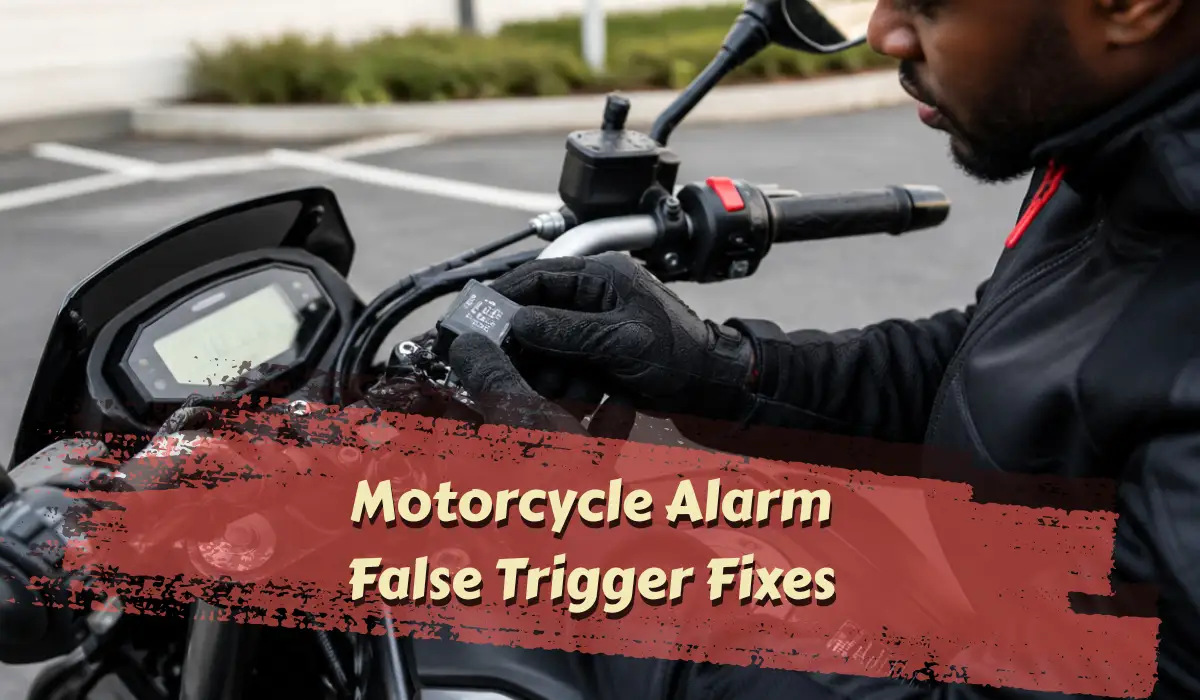
Is your motorcycle alarm going off for no clear reason? False triggers usually come from three areas: unstable power, oversensitive settings, or bad installation details. If you fix those in order, most nuisance alarms disappear.
This guide gives a repeatable diagnostic flow so you can stop random triggers without replacing good hardware.
Jump Ahead To:
Why False Alarms Happen
Most systems are not truly broken. They are reacting to noise they interpret as theft events.
Common causes:
- battery voltage dips and charging instability
- shock or tilt sensitivity set too high
- loose mounting and wiring vibration
- electrical interference from ignition components
- cover flapping or bad parking environment setup
If you are still choosing alarm hardware, start with the best motorcycle alarms guide.
Match the Symptom Before You Change Settings
Not every false trigger starts the same way, and the timing often tells you where to look first. If the alarm fires right after arming, suspect power instability, a switch input, or an overly sensitive sensor. If it only happens in one parking spot, the environment is usually part of the problem. If it happens while riding or with the key on, the charging system or wiring layout deserves extra suspicion.
That is why random menu changes are usually the wrong first move. A useful fix starts with pattern recognition, not with turning sensitivity all the way down and hoping for the best.
Step 1: Check Power and Battery Health First
Before touching settings, verify battery and charging condition.
- check resting battery voltage
- check voltage behavior under load
- inspect terminals and ground points for corrosion or looseness
Weak batteries often cause alarm resets that look like random triggers. If charging is unstable, fix that first before reprogramming sensors.
Resting voltage alone is not enough. A battery can look acceptable at rest and still collapse under load. If the voltage drops hard during cranking or dips low enough to reset the alarm module, the system may behave as if it detected tampering when the real issue is electrical weakness.
This is also where loose terminals and bad grounds waste time. A slightly corroded connection can create exactly the kind of intermittent voltage behavior that makes an alarm seem haunted.
Step 2: Read Trigger Codes or Alert History
Many alarm systems provide a clue about which sensor fired. Use LED flash patterns, beep patterns, or app logs to identify the trigger source.
If you skip this step, you end up guessing and changing the wrong setting.
This matters because shock, tilt, and current-sense problems do not get fixed the same way. A tilt-trigger pattern points you toward bike angle, stand stability, or sensor orientation. A current-sense trigger points you back toward battery condition, charging irregularity, or connection quality.
Step 3: Lower Sensitivity in Controlled Steps
Drop shock or motion sensitivity one level at a time, then test in your normal parking environment. Big jumps can over-correct and reduce real tamper detection.
If your bike is parked in windy or vibration-heavy spots, consider transport/ferry mode where supported.
The goal is not zero sensitivity. The goal is a setting that still reacts to real tampering without treating every gust of wind or passing truck as an attack. Many nuisance alarms come from riders maxing sensitivity and then blaming the hardware for doing exactly what they told it to do.
Step 4: Fix Mounting and Wiring Layout
A loose module can trigger itself from normal vibration. Re-mount alarm units to stable points, not flexible trim or unsupported panels.
Also route alarm wiring away from high-noise ignition lines where possible. Electrical noise can mimic trigger events on sensitive systems.
Mounting quality matters more than it looks. A module tied to thin plastic or mounted near fans and other vibrating parts can create constant false input. Rigid mounting on a stable frame or subframe area is usually the cleaner answer.
Wiring layout also matters because ignition components can throw electrical noise into nearby alarm wiring. Keeping distance, avoiding long parallel runs beside high-voltage lines, and cleaning up sloppy routing can solve problems that sensitivity changes never will.
Step 5: Solve Environmental Trigger Sources
If the alarm only false-triggers outside, parking environment is probably part of the problem.
Check for:
- loose cover flapping against bars or fairings
- parking near heavy truck vibration paths
- rain and moisture around sensitive connectors
- repeated movement from unstable side-stand surfaces
For outside-locking workflow, combine this with how to lock a motorcycle outside.
Cover movement is one of the most common examples. A cover that looks harmless can behave like a sail in wind, transferring repeated vibration into bars, bodywork, or the alarm module itself. Tightening the cover or using a transport-style sensor mode is often more effective than endlessly lowering shock sensitivity.
Weather can also change the trigger pattern. Rain, rapid temperature changes, and vibration-heavy parking surfaces can all turn a borderline setup into a noisy one.
When to Suspect the Charging System, Not the Alarm
If the alarm behaves oddly while riding, after startup, or during charging fluctuations, the bike's electrical system may be the real fault. Overvoltage and unstable charging can confuse or even damage alarm electronics.
That is why false-trigger troubleshooting should include the charging side, not just the alarm side. If bulbs are blowing, battery behavior is erratic, or the bike shows other electrical weirdness, stop treating the alarm as the only suspect.
Long-Term Parking and Battery Drain
Alarm systems draw power even when they are behaving normally. That can become a problem during long storage periods or infrequent riding, especially on smaller batteries or bikes with other parasitic drain.
If your alarm supports a winter, sleep, or transport mode, use it when the bike will sit for extended periods. A healthy alarm setup is not just one that avoids false triggers. It is also one that does not quietly flatten the battery over a week or two of inactivity.
When Replacement Actually Makes Sense
Do not replace the alarm first just because the symptoms are annoying. Replace it after you have checked power stability, mounting, routing, trigger history, and environment and the unit still behaves inconsistently.
That is especially true when the problem appears only in one location or only under one weather pattern. Those clues usually point to setup, not hardware failure.
Quick Troubleshooting Flow
- Confirm battery and charging health.
- Read sensor trigger history.
- Reduce sensitivity one step.
- Re-mount module and clean wiring runs.
- Re-test in same parking environment.
- Only replace hardware after stable testing cycle.
If theft risk is high while you tune alarms, add physical layers from best motorcycle chain locks and best motorcycle disc locks.
Common Mistakes
- Maxing sensitivity and expecting zero false alarms.
- Replacing alarm hardware before testing battery health.
- Mounting sensor units on vibrating plastic panels.
- Treating alarm logs as optional.
- Running alarm-only security with no lock layers.
Safety and Reliability Notes
Do not ignore charging faults. Over- or under-voltage can damage both alarm hardware and bike electronics.
For long parking periods, prevent battery drain with proper storage routines. Alarm systems still consume power even when idle.
If your bike uses factory security electronics or a complex loom, be careful with invasive rewiring. Poor alarm fixes can create new electrical problems faster than they solve old ones.
Related Security Upgrades
Alarm tuning is one part of a full theft-prevention system. Build stronger physical delay layers with best motorcycle ground anchors, best motorcycle U-locks, and best motorcycle wheel clamps.
For lock strategy planning, compare disc lock vs chain lock for motorcycles and the motorcycle theft prevention guide.
Frequently Asked Questions
Why does my alarm trigger when my bike cover moves?
Cover flap movement can transfer vibration to bars and bodywork, which shock sensors treat as tampering.
Can a weak battery cause false alarms?
Yes. Voltage drops can reset alarm logic and trigger nuisance alerts.
Should I lower sensitivity to minimum?
Usually no. Lower in small steps so you keep useful tamper detection.
Why does my alarm trigger in one parking spot but not another?
Local vibration, wind patterns, or interference can change trigger behavior by location.
Do I need to replace my alarm unit immediately?
Not usually. Most false-trigger issues are setup or electrical problems first.
Can wiring placement cause alarm issues?
Yes. Poor routing near noisy components can create false trigger signals.
What should I add while fixing alarm issues?
Add physical lock layers so security stays strong during troubleshooting.
If you want a full anti-theft structure beyond alarm tuning, use best motorcycle locks as the main hub and then apply the parking workflow from how to lock a motorcycle outside.