
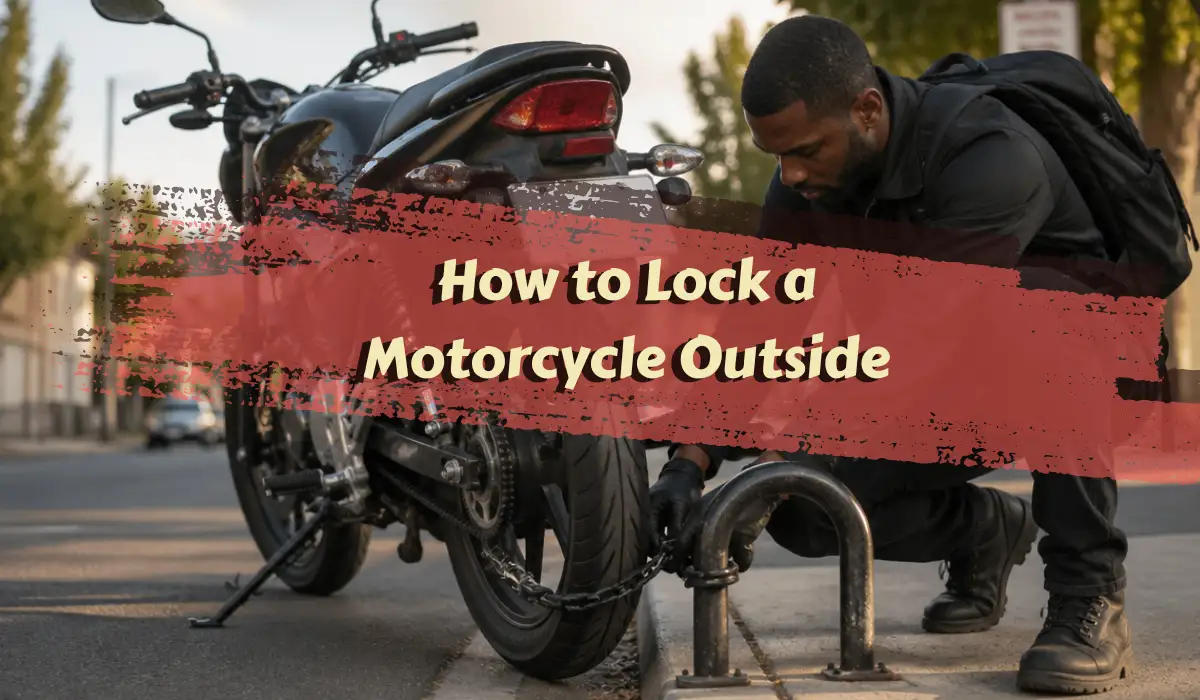
Is locking a motorcycle outside really that different from garage parking? Yes, because outdoor parking adds more exposure, more tool access for thieves, and fewer natural barriers. One lock is rarely enough in medium-to-high risk areas.
The goal is not perfect security. The goal is making theft take longer, louder, and riskier than nearby targets. This guide gives a practical outside-locking routine you can repeat every day.
Jump Ahead To:
Why Outside Locking Needs a Layered Setup
Outside parking exposes your bike to lift-and-van theft, fast hand-tool attacks, and opportunistic tampering. A single lock usually stops only one theft path.
Layered security works better: anchor layer, immobilizer layer, and visibility control layer. Start with the full best motorcycle locks hub if you are still building your kit.
Core Locking Principles
Anchor to something immovable
Whenever possible, secure the bike to a fixed object or installed anchor. If you only immobilize a wheel without anchoring, the bike can still be lifted.
Lock through frame or swingarm
Do not depend on front-wheel-only lock routing. Prioritize frame or swingarm pathways.
Keep chain and lock off the ground
When hardware sits on the ground, tool leverage gets easier. Keep routing tight and elevated where possible.
Add a second lock layer
A second lock type forces thieves to switch tools and techniques. That extra time is valuable.
Pick the Spot Before You Touch the Locks
Outside security starts with parking choice, not hardware. A well-lit spot with regular foot traffic, nearby windows, or camera coverage gives thieves less privacy and less time to work.
If you have options, avoid isolated corners, deep shadows, and places where a van can stop right beside the bike without drawing attention. Even a strong chain setup is better when the bike is parked somewhere awkward for thieves rather than convenient for them.
When you are using street furniture, also check whether the object is truly solid and whether local rules allow you to lock to it. A railing that bends, a removable signpost, or a location that gets your lock cut off by property management is not real protection.
Step-by-Step Outside Parking Routine
- Choose the most visible, well-lit spot you can.
- Lock frame or swingarm to an immovable object using a hardened chain.
- Keep chain slack minimal and avoid ground-resting lock placement.
- Add a disc lock or other wheel immobilizer.
- Engage steering lock as a secondary delay, not your primary defense.
- Cover the bike when possible to reduce model visibility.
- Arm your alarm/tracker layer before leaving.
The order matters. Anchor first, then add immobilization, then hide and monitor. Riders sometimes do the easy step first, like putting on a disc lock, and then skip the harder anchoring step when they are in a hurry. That is exactly how a decent kit turns into weak real-world security.
If you only change one habit after reading this guide, make it this: treat anchoring as the main job and everything else as support. Outside parking gets much weaker when the bike is only locked to itself.
For hardware picks, use best motorcycle chain locks, best motorcycle disc locks, and the best motorcycle alarms guide.
What to Do When No Fixed Anchor Is Available
If no fixed point exists, use stronger immobilization layering:
- disc lock plus second wheel lock
- visible wheel clamp
- alarm plus cover
- tracker activation and alert checks
Then reduce exposure time. In anchor-poor locations, parking duration becomes a major risk multiplier.
This is where many riders need to be honest about the limit of their setup. If the bike cannot be anchored, your goal shifts from true restraint to making removal slower, louder, and less appealing than easier nearby targets.
Parking the bike close to a wall or curb can also reduce access angles, but that does not replace anchoring. It only makes attack setup slightly less convenient.
If the Frame Is Hard to Reach
Some motorcycles do not give you an easy chain path through the frame. In those cases, the swingarm may be the cleaner routing option, provided the chain cannot simply slide off.
If your bike has a hollow axle, a hardened pin system can sometimes create a usable attachment point where a chain alone would not fit cleanly. That kind of workaround matters on bikes with tight frame packaging.
Another fallback is combining a smaller high-security best motorcycle U-locks setup with a chain or anchor point when geometry allows it. The point is not to use a specific format at all costs. The point is to create a real connection between the bike and something immovable.
Home Driveway and Apartment Parking Setup
If you park in the same place often, install a fixed anchor. That usually gives the biggest security upgrade per dollar.
Use the best motorcycle ground anchors guide for anchor options, then add supporting layers like best motorcycle U-locks or best motorcycle wheel clamps.
For repeat parking spots, think in terms of a parking system rather than a portable kit. The chain or anchor that feels too heavy for everyday travel may be exactly the right choice when it lives permanently at home.
Apartment parking adds one more variable: shared access. In that case, visible deterrence, camera coverage, and a cover often matter even more because more people can observe the bike, the locks, and your routine.
Cover and Tracker Strategy
A cover does more than protect paint. It hides the model, hides your security hardware, and forces a thief to interact with the bike before deciding whether it is worth the trouble. That small friction matters.
If the cover has lockable grommets or a bottom strap, use them. The goal is not to make the cover impossible to remove. The goal is to make quick visual inspection and instant grab attempts less convenient.
Trackers are different from locks because they do not prevent theft directly. They support recovery. That is why the best tracker setup is one that is hidden well and treated as a backup layer, not as permission to get lazy with physical security.
Avoid obvious tracker locations like under-seat storage if there are better hiding spots deeper in the bike. Thieves know where easy-access electronics usually sit.
What Changes in Higher-Risk Areas
In higher-risk parking zones, standard "good enough" hardware becomes less convincing. This is where stronger lock ratings and more attack-resistant materials start to matter.
As a general benchmark, motorcycle-focused independent ratings are more useful than vague heavy-duty marketing. For riders dealing with repeated outdoor parking in exposed areas, stronger Gold or Diamond level hardware is the more serious starting point.
This is also the situation where layered roles become clearer. A chain or anchor handles restraint, a disc lock adds secondary immobilization, an alarm adds noise, a cover adds concealment, and a tracker supports recovery if everything else fails.
Outside-Locking Mistakes That Cost More Than People Expect
The first expensive mistake is building a kit around the easiest lock to carry instead of the hardest situation you face most often. If the bike sleeps outside, home-base restraint deserves most of the budget.
The second is wasting money on weak primary hardware. Cable locks and other light "cafe stop" options are fine for accessories or supervised short use, but they are not serious outside security for the bike itself.
The third is making your routine too complicated to repeat. A theoretically perfect setup that you skip on tired nights is worse than a strong routine you actually use every time.
Common Mistakes That Make Outside Locking Weaker
- Locking only the front wheel.
- Leaving chain and lock on the ground.
- Relying only on steering lock.
- Skipping lock use for "just a quick stop."
- Using one lock type for every risk level.
- Mounting trackers in obvious locations.
Safety and Legal Notes
Check local parking rules before locking to street furniture. Some places allow certain fixtures; others restrict them.
Also build safe lock handling habits. Heavy chain carry and rushed lock-up routines can create avoidable rider risk.
Quick Outside-Locking Checklist
- Spot is visible and not isolated.
- Bike is anchored to fixed object where possible.
- Chain path includes frame or swingarm.
- Chain and lock are not resting on ground.
- Secondary lock is installed.
- Steering lock engaged.
- Cover fitted if practical.
- Alarm/tracker active.
If your alarm keeps over-triggering, tune setup with the motorcycle alarm false-trigger fixes guide.
Frequently Asked Questions
Is one disc lock enough for outside parking?
For short low-risk stops, sometimes. For longer or higher-risk parking, add anchoring and another lock layer.
Should I lock to a wheel or the frame?
Frame or swingarm routing is usually stronger for primary lock placement.
Do motorcycle covers help with theft prevention?
Yes. Covers reduce visibility and make target selection harder for opportunistic thieves.
Is steering lock useful?
Yes, but only as a secondary layer. Do not rely on it alone.
What lock should I buy first?
Start with a quality chain setup if anchoring is possible, then add a secondary immobilizer.
What if I cannot anchor to anything?
Use two immobilizer layers, alarm support, and minimize unattended time.
Is a tracker enough without strong locks?
No. Trackers help recovery, but physical locks are still your first defense.
For full planning, combine this guide with disc lock vs chain lock for motorcycles and the motorcycle theft prevention guide to match lock depth to your parking risk.