
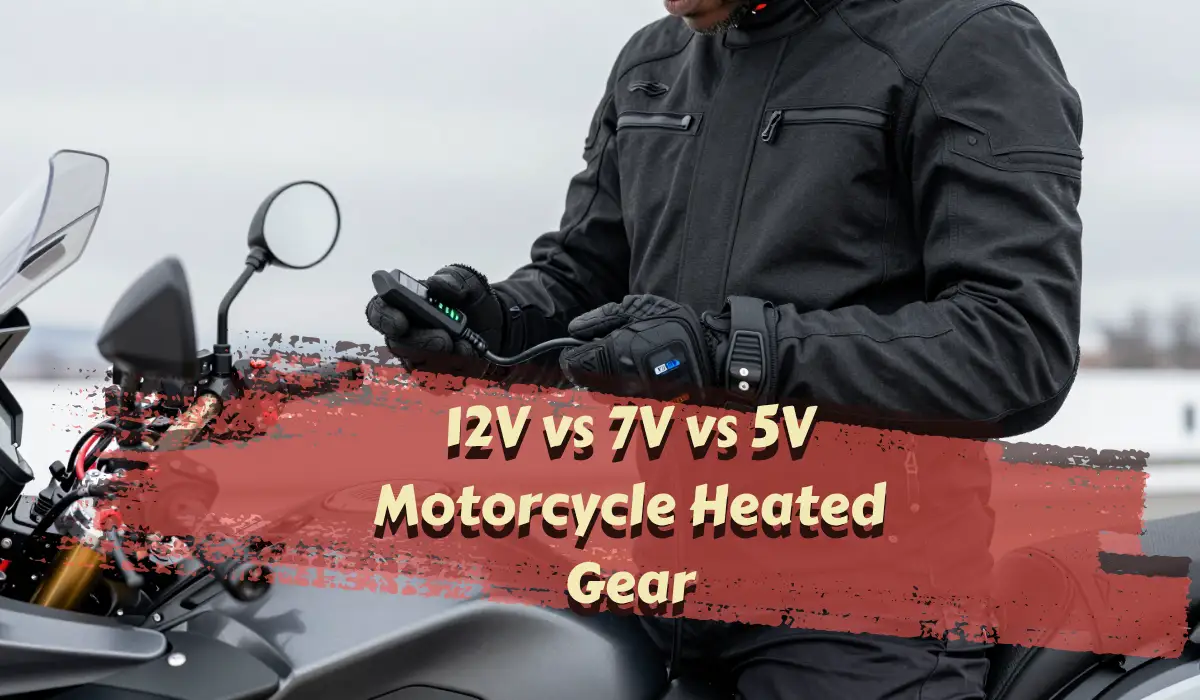
Is 12V vs 7V vs 5V motorcycle heated gear really a big deal on the road? Yes. Pick the wrong system and you can end up with weak heat, dead batteries, or a setup that trips the bike's accessory circuit halfway into a cold ride.
This guide shows what each voltage class actually does well, where it starts to fall apart, and which riders should use it. If you want the full heated-gear overview first, start with the main heated motorcycle gear guide.
Jump Ahead To:
What These Voltage Systems Actually Mean
12V systems
12V heated gear pulls power directly from the motorcycle while you ride. That is why it is still the strongest choice for long cold days and full multi-piece systems. It can support bigger heating zones, higher peak heat, and ride-length runtime as long as the bike has enough electrical headroom.
7V systems
7V or 7.4V heated gear uses dedicated wearable battery packs. It sits in the middle of the market: stronger than most USB-based gear, but easier to live with off the bike than a full tethered 12V setup.
5V systems
5V heated gear runs from USB power banks. It is the easiest point of entry because replacement batteries and chargers are everywhere, but it usually gives up heat output, coverage, and cold-weather authority once speed and wind chill get serious.
How Voltage Changes Heat on the Road
The short version is simple: higher system voltage usually supports more heat and more coverage. That does not mean every 12V garment beats every 7V garment, but the platform ceiling is different.
Typical source ranges look like this:
| System | Usual strength | Typical use |
|---|---|---|
| 12V | highest peak heat and the largest heating zones | touring, highway winter riding, full heated suits |
| 7V | solid middle ground for portable warmth | commuting, mixed on-bike and off-bike use |
| 5V | lowest ceiling for output and coverage | casual cold-weather use, short trips, lighter cold |
That matters most in hard wind chill. A 12V liner or glove can keep feeding heat at highway speed in ways a smaller battery platform may struggle to match. If your hands are the weak point, that difference shows up fast in the heated glove guide. If your core keeps falling behind on longer rides, compare the heated jacket liner guide and the heated vest guide.
Runtime: The Part Riders Usually Misjudge
12V: ride-length runtime
As long as the engine is running and the bike can support the electrical load, 12V runtime is basically tied to ride length. That is the biggest reason long-distance winter riders keep coming back to it.
7V: good real-world portability
7V systems often work well for short and medium rides, and many products claim 2 to 8 hours depending on mode. The catch is that high heat shortens that number fast. In true winter use, high settings can drop closer to the 1.5 to 2 hour range.
5V: biggest gap between claims and real winter use
5V gear can look attractive because USB batteries are cheap and common. The problem is that real high-heat winter performance is limited, and many 5V garments use smaller heating zones to stay within what the power bank can actually supply.
That is why some riders love 5V gear for short commutes or walking around town, then replace it later for real cold-weather riding. If your feet are the first thing to quit, the heated socks and insoles guide shows where portable systems still make sense.
Heat Zones and Peak Heat Matter More Than People Expect
Voltage is not only about runtime. It also changes how much heated surface a garment can support and how hard that garment can keep working once the wind hits it.
That is why 12V gear keeps showing up in serious touring and winter systems. The platform can support larger heated areas and stronger peak temperatures. In practical use, that means a real 12V jacket liner can warm collar, chest, back, and sleeves together in a way smaller battery systems usually cannot match.
7V gear sits in the useful middle ground. It can still give real warmth, and the best pieces are absolutely good enough for many riders. But the heating zones are usually smaller, and the gap shows up faster once the ride gets longer or colder.
5V gear is where the marketing gap gets biggest. On paper, it can still sound warm. On the bike, high-speed convective heat loss changes the equation. A casual heated layer that feels fine standing around can feel much weaker once it is trying to fight highway wind through a riding shell.
That does not make 5V useless. It just means you need to be honest about the job. It is better for lighter cold, short trips, and convenience-driven use than for deep winter riding where hands and core are already losing ground.
Bike Electrical Compatibility Matters More Than Marketing
12V gear only works well when the motorcycle can support it. You need to know how much usable wattage is left after the bike covers its normal running load.
That means looking at:
- total output at riding RPM
- the base electrical load from the bike itself
- the combined draw of the heated gear you plan to run
- a safety margin so the battery still charges
Many source packs point riders toward a simple rule: do not treat the full surplus as yours. Leave real margin instead of planning right up to the limit.
A Simple Usable-Wattage Check
Riders often hear that they should "check stator output" but never get a practical way to think about it. The simple version is this:
- Find the bike's total electrical output at riding RPM.
- Subtract the bike's normal running load.
- Keep a safety margin instead of spending every last watt on heated gear.
That safety margin matters because heated gear is not the only thing happening on the bike. Lights, fuel injection, ECU loads, charging recovery after cold starts, and lower output at idle all change what is really available.
The exact number varies by motorcycle, but the decision pattern is usually clear. Big touring and ADV bikes often have enough surplus for a real 12V system. Small dual-sports, older bikes, or lightly equipped machines may not. That is why a full 12V suit makes sense on one bike and feels like a terrible idea on another.
If you are anywhere near the limit, do not build the whole plan around perfect conditions. Leave margin and size the system like something will go wrong, because eventually it will.
CAN Bus Bikes and Factory Ports
This is where a lot of riders get burned. Many factory accessory ports on CAN bus bikes are current-limited, and heated jackets often pull more than those ports are willing to allow.
In practical terms, that means:
- a factory DIN or accessory outlet may cut power when a heated jacket is plugged in
- a direct fused battery harness is often the safer answer
- smart modules like ezCAN-style systems can help on bikes that do not like accessory overload
If you are dealing with that part of the puzzle now, go straight to the heated gear wiring guide and the heated gear controller guide.
When Hybrid Systems Make Sense
Some riders do not want to choose between full 12V tethering and full battery portability. That is where hybrid or dual-power systems can make sense.
The idea is simple: run from the bike when riding, then switch to an internal battery when you are off the bike. That is useful for touring riders who stop often, commute riders who still want warmth away from the motorcycle, or anyone trying to bridge a mixed-use setup.
The tradeoff is complexity. Hybrid gear costs more, weighs more, and adds another layer of charging, cable, and controller planning. It is not the right answer just because it sounds flexible. It is the right answer when your actual riding pattern keeps crossing between on-bike and off-bike use.
The Cost Story Changes After the First Month
Riders often compare heated systems by sticker price alone, then get surprised later by the real cost of living with the setup.
12V usually asks for more money up front because the full answer is not only the garment. It is the garment, the harness, and often the controller. But once the bike is wired, the day-to-day routine gets simpler. You are not charging multiple packs every night, and you are not buying extra batteries just to make a longer ride workable.
7V usually feels easier to justify early because the garment is more self-contained. The catch is that frequent riders often end up buying spare packs, extra chargers, or replacement batteries once the originals age. That does not make 7V bad. It just means the cheaper-looking path is not always the cheaper long-term path.
5V is the easiest entry point, but it also carries the highest risk of buying twice. A lot of riders start there because the cost and convenience look great, then replace it once the cold gets serious and the gear cannot keep up at speed.
So the right money question is not only "What costs less today?" It is "What setup still makes sense after one full winter of the way I actually ride?"
Which System Fits Your Riding Style
Daily short commuting
7V often makes the most sense here. It is warm enough for many short rides, portable off the bike, and does not ask you to build a full wiring system on day one.
Long-distance winter touring
12V is usually the right answer. It gives the most stable high-output heat and does not leave you juggling battery packs when you are three hours into a freezing ride.
Bikes with limited electrical surplus
Portable 7V gear can be the smarter move if the motorcycle does not have much extra wattage to give. Small dual-sports and some lighter bikes make this tradeoff unavoidable.
Mixed on-bike and off-bike use
7V is the best compromise when you need heat on the bike and still want the garment to make sense when you are off it.
Lowest-cost entry point
5V is the easiest way to try heated apparel, but riders who regularly face highway cold usually outgrow it faster than they expect.
Cool Weather and Real Winter Are Not the Same Job
This is where a lot of heated-gear advice gets muddy. A setup that feels good on a cool forty-minute ride is not automatically a real winter system.
In lighter cold, especially if the ride is short and the bike has decent wind protection, 7V can feel like the sweet spot. It gives enough warmth to matter, stays portable, and does not ask you to wire the bike first. In that same kind of use, 5V can still make sense for core warmth or foot warmth if the rider mainly wants convenience.
Once the ride moves into long highway miles, heavy wind exposure, or temperatures near freezing, the platform gap gets much bigger. That is where 12V starts feeling less like overkill and more like the right tool. It keeps feeding heat without shrinking runtime every time you bump the setting high enough to matter.
That is also why body zone matters. A 7V vest can still feel useful in conditions where 7V gloves start to struggle. The core gets some help from the shell. Fingers do not. So when riders say a portable system "worked fine" or "felt weak," always ask what body part they are talking about and what kind of ride they were doing.
Match the Voltage to the Body Zone
Different body zones hide the limits of lower-voltage systems differently. A portable vest can still feel useful because the core starts with some protection from the shell. Gloves, by contrast, have to fight wind directly at the fingertips, which is why the jump from casual portable heat to strong 12V hand heat feels so dramatic.
That also explains why feet are a mixed case. Heated socks and insoles can work well on portable systems because boots already trap some warmth. But if the boot is tight, the wind is hard, or the rest of the body is already losing heat, even good foot heat can feel disappointing.
The easy rule:
- core heat tolerates portable systems better than hands do
- hand heat exposes weak systems faster than almost anything else
- foot heat depends heavily on boot fit and the rest of the thermal setup
If you build by body zone instead of by hype, the voltage decision usually gets clearer.
What Riders Get Wrong About Runtime Claims
Runtime claims are not fake, but they are easy to misunderstand. Brands usually quote their best-looking numbers on low or medium settings in controlled conditions. Riders then expect those same numbers in freezing wind, at highway speed, with the heat pushed high enough to actually matter.
That is where disappointment starts. The real winter question is not "How long can this battery last?" It is "How long can this battery last at a heat level that still feels useful on the bike?"
That is why 7V often stays believable for commuting while 5V feels optimistic in harder use. It is also why 12V keeps winning long cold rides. The bike is doing the power work instead of a pocket battery that is already being asked to perform in bad weather.
Big Bikes, Small Bikes, and Why the Same Advice Fails
Riders get confused because heated-gear advice is often written like every motorcycle has the same electrical life. It does not.
A larger touring or ADV bike can often support a much more serious 12V plan than a smaller dual-sport or older lightweight machine. That is why one rider can treat a 12V jacket and gloves as normal daily equipment while another rider trips the system or ends up with weak heat as soon as traffic slows down.
So when you see a confident heated-gear recommendation, run it through one filter first: what kind of bike is it being recommended for? That question changes everything.
Why 12V Feels So Different at Speed
The biggest real-world gap shows up on exposed body zones at highway speed. A 12V glove or jacket liner keeps pushing enough heat to fight back against wind-chill in a way lower-voltage systems often cannot sustain.
That is why riders sometimes think the category hype around 12V is exaggerated until they ride in real freezing wind. Then the difference stops feeling theoretical very quickly.
5V Still Has a Real Job
5V is easy to dismiss, but it still has a place. It is useful for lighter cold, low-cost entry, and riders who care more about convenience than maximum output.
The mistake is not buying 5V. The mistake is expecting it to behave like a 12V touring system once speed, wind, and ride length all increase.
Quick Decision Flow
- Decide how cold your real rides get and how long they last.
- Check whether the bike can safely support 12V heated gear.
- Decide if you need true off-bike mobility.
- Match the platform to the body zone that fails first.
A simple way to think about it:
- choose 12V when you want the strongest heat and ride-length runtime
- choose 7V when you want real warmth without full bike tethering
- choose 5V when convenience and low buy-in matter more than deep-cold performance
Then build by problem area. Use the heated jacket liner guide if upper-body heat is the weak link, the heated pants liner guide if your legs freeze first, and the heated grips guide if you want palm-side heat without changing gloves.
Safety Notes You Should Not Ignore
- Do not assume a factory accessory port can handle a heated jacket.
- Do not plan a 12V setup without checking electrical surplus first.
- Do not judge battery runtime from low-heat marketing numbers if you ride in real freezing wind.
- Do not mix connectors and controllers blindly across brands without checking compatibility.
If your current setup already feels unstable, run it through the heated gear troubleshooting guide before you buy more gear to compensate for a wiring or charging problem.
Common Mistakes Riders Make
- Choosing by battery-runtime claims alone.
- Assuming 5V gear will behave like 12V gear at highway speed.
- Buying 12V gear before checking the motorcycle's electrical headroom.
- Forgetting that heated gloves and liners usually need more than a simple accessory socket.
- Building a system around off-bike portability when the real problem is long on-bike winter mileage.
Frequently Asked Questions
Is 12V always better than 7V or 5V?
Not always. It is the strongest platform for heat and runtime, but it only makes sense if the bike can support it and you are okay with the wiring.
Is 7V enough for winter commuting?
For many riders, yes. It is often the best middle ground for short and medium rides.
Can 5V heated gear work for motorcycle riding?
Yes, but it works best for lighter cold, shorter trips, and riders who value convenience over maximum heat.
Why does my heated gear shut off on a CAN bus bike?
The bike may be detecting too much current draw on a monitored circuit and shutting the port down to protect itself.
Will a full 12V suit drain my battery?
It can if the bike does not have enough usable surplus or if you spend too much time idling with high draw turned on.
Can I mix different voltage heated gear types?
Yes, but it makes the overall setup more complex because now you are managing separate power sources, charging routines, and controllers.
What should I upgrade first if my system feels weak?
Most riders get the biggest gain by fixing core layers, power delivery, or controller setup before buying random extra garments.
Next step: map the full setup with the heated gear controller guide, the heated gear wiring guide, and the heated gear layering and sizing guide.