
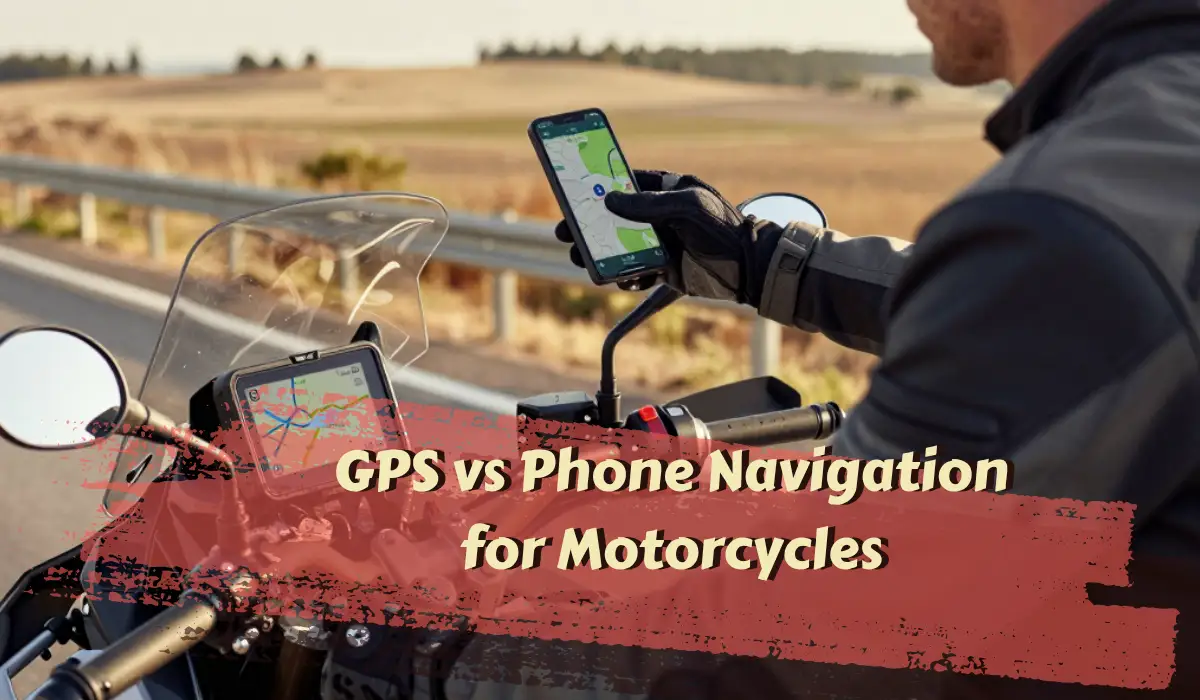
GPS vs phone navigation for motorcycles is not a simple yes-or-no choice anymore. A phone setup can work great in the city, while long tours and rough weather often expose its weak points fast. This guide helps you choose the right navigation setup by ride type, risk level, and budget.
If you are still selecting hardware, compare best motorcycle gps, best motorcycle phone mount, and motorcycle phone mount vibration camera protection alongside this article.
Jump Ahead To:
What Changes on a Motorcycle
Motorcycle navigation lives in harsher conditions than car navigation. You deal with direct sun, rain pressure, high vibration, glove input, and smaller charging margins. A setup that seems fine on short rides can fail on long highway days.
The three biggest failure points riders report are heat shutdown, camera damage from vibration, and power instability from weak charging setups. That is why this decision is less about app preference and more about reliability under stress.
Phone Navigation Strengths and Limits
Phone navigation wins on app ecosystem, route flexibility, and convenience. You already know the interface, updates are fast, and apps like Google Maps or other route planners are easy to use. For commuting and short day rides, that can be enough.
But phones have real exposure on bikes. High-frequency vibration can damage OIS camera systems over time. Direct sun and charging load can trigger thermal dimming or shutdown. Capacitive touch with gloves is also less reliable than many motorcycle-specific units. These are not edge cases for riders who do long days.
Dedicated GPS Strengths and Limits
A dedicated motorcycle GPS usually wins on durability and consistency. You get weather-rated hardware, sunlight-friendly displays, glove-ready interaction, and offline mapping built into the core workflow. For touring and remote routes, that reliability is hard to beat.
The tradeoff is cost and software feel. Dedicated units can feel slower or less app-flexible than modern phones, and the up-front price is higher. But for riders who depend on navigation every ride, avoiding phone failures often offsets that cost.
The Middle-Ground Setup Most Riders Should Consider
A smart display setup is now the practical middle path for many riders. You mount a rugged CarPlay/Android Auto screen on the bike, keep your phone safer in a pocket or protected location, and still use familiar apps.
This approach solves a lot of direct-mount risk while keeping app convenience. It does not remove all phone dependence, but it reduces exposure to rain impact, heat soak on bars, and vibration stress to camera modules.
Best Choice by Ride Type
City commuting and short daily rides
A phone plus quality dampened mount is often enough. Keep charging stable and avoid rigid no-dampener mounts.
Long paved touring
Dedicated GPS or smart-display systems are safer for visibility and all-day reliability.
Adventure and remote routes
Dedicated GPS or rugged tablet workflows are stronger because offline reliability and weather tolerance matter more.
Mixed riding with tight budget
Start with phone + dampened mount + proper power management, then upgrade to a dedicated screen when failures begin to show.
Pre-Ride Navigation Checklist
- Confirm mount security and steering clearance.
- Verify dampener use if phone has OIS camera hardware.
- Download offline maps before leaving coverage areas.
- Confirm charging works at riding RPM, not just at idle.
- Keep a backup nav option (paper map, second device, or preplanned route notes).
For charging reliability, build this with best motorcycle USB chargers and motorcycle USB power management guide.
Common Failure Patterns and Fixes
Camera focus gets blurry after rides
Cause: vibration damage to OIS/AF components. Fix: use dampened mounts, relocate phone, or switch to smart display / dedicated GPS.
Screen becomes unreadable in sunlight
Cause: heat dimming or low brightness ceiling. Fix: switch to brighter display hardware and reduce direct phone exposure.
Navigation dies mid-ride from battery drain
Cause: charger output too low or unstable wiring. Fix: upgrade to higher-output charger and switched, fused wiring strategy.
Gloves make touch input unreliable
Cause: capacitive screen limitations. Fix: glove-compatible display or better glove fingertip support.
Safety Rules That Matter
- Do not mount high-value phones rigidly on high-vibration bikes without dampening.
- Do not depend on live cellular data only for remote rides.
- Do not treat one navigation device as your only emergency option.
- Keep screen placement in your natural sightline to reduce long glances.
For better cockpit safety integration, pair this with best motorcycle dash cams and helmet comms installation and audio tuning.
Decision Summary
Use a phone setup for simple local rides if you protect it properly. Use dedicated GPS for highest reliability in weather and long-distance scenarios. Use a smart-display middle ground if you want phone app convenience with lower exposure risk.
Most riders should decide by failure cost. If losing navigation for 10 minutes is minor, phone-first is fine. If losing navigation can put you in unsafe or remote situations, move to dedicated or hybrid hardware sooner.
Frequently Asked Questions
Is phone navigation enough for motorcycle touring?
It can be, but long-distance touring increases heat, vibration, and power risks where dedicated or hybrid systems perform better.
Why do riders still buy dedicated GPS units?
Because they are more consistent in sun, weather, gloves, and offline conditions.
Do vibration dampeners really reduce phone camera risk?
Yes, they significantly reduce transmitted vibration and lower camera damage risk.
Are smart displays better than direct phone mounts?
For many riders, yes. They keep app convenience while reducing direct phone exposure.
Should I still download offline maps if I use a dedicated GPS?
Yes. A backup route strategy is always smart, especially in remote areas.
Is a larger screen always better for navigation?
Only if it fits your cockpit safely and does not block controls or visibility.
What is the safest starter setup for new riders?
A dampened phone mount, reliable charger, and offline map habit is a strong starter setup.
If navigation is only one part of your cockpit, choose motorcycle Bluetooth headsets for route audio, use the motorcycle electronics setup guide to organize wiring and mounts, and carry rugged power banks for motorcycle camping when you ride away from outlets.