
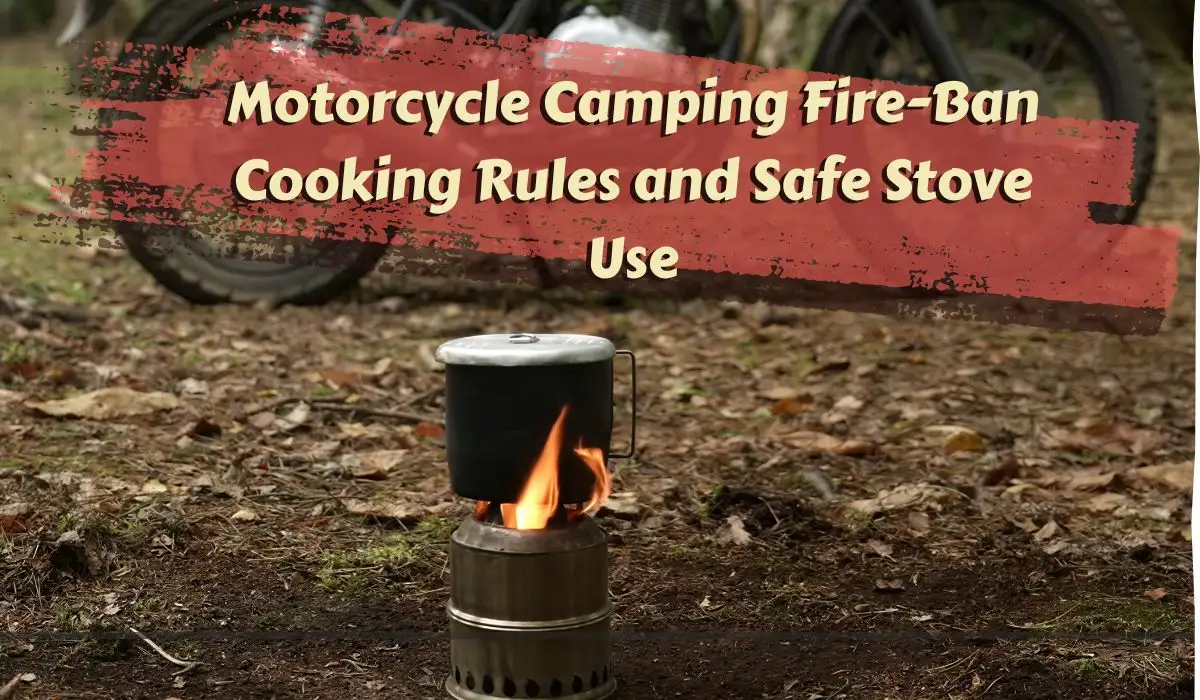
Is cooking during fire season while motorcycle camping a legal minefield? It can be, especially when you cross districts in one trip.
Fire-ban rules are not one-size-fits-all. A setup that was legal yesterday can be illegal today after a forest, district, field-office, or county order update. Add dry grass, fuel vapor, and a hot bike, and small mistakes become expensive fast.
The fix is simple: check the current restriction order before camp, run a valve-first stove check, and use one repeatable safety routine every time you light up. This article works best alongside the main motorcycle camping gear guide, because stove legality is only one part of the full camp setup.
Jump Ahead To:
Who These Rules Apply To
These rules apply to riders cooking on public land during fire season, including National Forest, BLM, and state-managed areas. If you do dispersed camping or move across multiple jurisdictions, this matters even more.
You are not just managing a stove. You are managing ignition risk around fuel, dry ground, wind, and hot machine parts.
How Fire-Ban Stages Change What You Can Cook With
Many agencies use a staged or leveled system, but the labels are not universal.
- Stage 1 usually limits open flame and often allows campfires only in permanent agency-provided structures at developed sites.
- Stage 2 is stricter and usually bans wood and charcoal entirely, even in many developed areas.
- Some agencies use Stage 3 or Level 3 language, while others move from fire restrictions to a closure order. Treat any closure or highest-level restriction as a major change that can end legal camp use entirely.
During serious restrictions, the key requirement is usually shut-off capability. Orders often allow only devices with a shut-off valve or a valve that lets the operator turn fuel flow on and off.
That is why alcohol and other non-valved flame systems are often not allowed when an order requires a shut-off valve, but the exact order controls.
Core Rules Riders Must Understand Before Ignition
Valve control is the common legal baseline
Pressurized gas or valved liquid-fuel stoves are usually the compliant path under many Stage 1 and Stage 2 orders.
Ground prep is not optional
Set up on barren ground or in an area cleared of flammable material. A 3-foot clearance appears in some orders, while other guidance uses 5 feet, so always follow the stricter local rule.
Bike spacing is best practice
Keep the stove 5-10 feet away from your motorcycle when space allows. That is smart safety spacing, not a universal legal rule, and it helps keep fuel vapors and hot exhaust parts out of your cook zone.
Suppression gear can be part of compliance
Some fire-season areas require riders or other motorized users to carry tools such as a shovel plus water or an extinguisher. Elsewhere they are strongly recommended. Carry them regardless, and if your route already pushes water planning hard, build that into your motorcycle camping water strategy.
Permit rules can stack on top of restrictions
In California, a gas stove or lantern may still require a campfire permit even when it is otherwise allowed under the current restriction order. If you cross state lines, check permit rules separately from restriction stages.
Fuel handling must account for heat
Follow the bottle's fill line and leave expansion space; do not top it off.
Safe Stove Workflow You Can Repeat at Every Camp
Check the current fire restriction stage or order for the exact district or field office. Use official land-manager sources, not yesterday's memory.
Confirm your stove meets that order's rules. Under stricter restrictions, assume valve-controlled systems only unless the local order clearly says otherwise.
Build a low-risk cook zone. Clear debris and flammable material around the stove site, and keep distance from grass, brush, tents, and luggage.
Park and stabilize the bike away from flame. Avoid placing your stove near venting fuel areas or hot metal surfaces.
Stage suppression tools before lighting. Keep water and shovel or extinguisher within immediate reach.
Cook with active supervision. Never leave flame unattended, even for quick tasks.
Shut down fully and verify flame-out. Close the valve, confirm no flame, and cool the system before packing.
Stop all camp activity if a closure order or highest-level restriction is declared. Do not enter or remain in closed areas.
Common Fire-Ban Cooking Mistakes Riders Keep Making
Treating a small alcohol stove as automatically safe. Fix: follow the exact order first; non-valved flame systems are frequently restricted.
Cooking next to the bike for convenience. Fix: create distance so tank vapors and hot exhaust are not part of your cook zone.
Using repurposed bottles for fuel. Fix: use fuel-rated containers only.
Lighting on uncleared ground. Fix: use barren ground or clear flammable material before ignition.
Starting flame without suppression tools ready. Fix: stage water plus shovel or extinguisher first, then light.
Ignoring cold-weather stove behavior. Fix: plan for weaker canister performance in cold and control wind exposure.
Safety Habits That Keep You Legal and Reduce Risk
- Verify spark arrestor compliance before fire-season travel.
- Recheck fuel caps and seals daily on rough, vibration-heavy trips.
- Keep smoking and any ignition source away from dry fuels and brush.
- Never run a stove inside enclosed shelters due to carbon monoxide danger.
- Pack one no-flame meal option for strict ban days or sudden rule changes.
Pair this with your broader kitchen and fuel plan in the camp kitchen setup guide and best motorcycle camping stoves. If you are still sorting what pot and utensils belong in a compliant low-fuss setup, compare motorcycle camping cookware sets.
Frequently Asked Questions
Can I use charcoal when a Stage 1 order is active?
Usually only in permanent agency-provided structures at developed sites. Portable charcoal use is often restricted.
Are wood or twig stoves allowed during active fire bans?
In most restricted conditions, no. They are usually treated as open flame.
Is an alcohol stove legal during Stage 2?
Often not when the order requires a shut-off valve. Check the exact local order before use.
Are solid-fuel tablets legal during active restrictions?
Not automatically. Orders that require a shut-off valve often do not treat non-valved solid-fuel systems the same way as gas or pressurized liquid-fuel stoves, so check the exact order before use.
How much ground do I need to clear around a stove?
Some orders use 3 feet, while others use 5 feet. Follow the stricter local rule and clear all flammable material around the stove site.
Do riders really need a shovel or extinguisher?
Sometimes yes. Some jurisdictions make tool requirements mandatory for motorized use, while others strongly recommend them.
Can I still cook if an area moves to Stage 3 or closure?
Usually no. If the order is a closure, public entry and camp use are off the table. Some agencies use different labels, so read the exact order text.
What is the safest backup when rules get stricter mid-trip?
Use no-flame meals like cold-soak options until you reach a legal cooking zone.
For the rest of your camp system, see the motorcycle camping checklist, motorcycle camping cookware sets, and motorcycle camping first aid kits. If dry conditions change where and how you cook, it also helps to review how to pack motorcycle camping gear with dry bags so fuel and stove gear stay isolated and easy to reach.